Nemastoma lugubre
| Nemastoma lugubre (Müller, 1776) | |||||||||||||||||||||||||||||||||||||||
|---|---|---|---|---|---|---|---|---|---|---|---|---|---|---|---|---|---|---|---|---|---|---|---|---|---|---|---|---|---|---|---|---|---|---|---|---|---|---|---|
| Östlicher Silberfleckkanker (Komposch 2009) | |||||||||||||||||||||||||||||||||||||||

| |||||||||||||||||||||||||||||||||||||||
| Männchen | |||||||||||||||||||||||||||||||||||||||
| Systematik | |||||||||||||||||||||||||||||||||||||||
| Ordnung: Opiliones (Weberknechte) | |||||||||||||||||||||||||||||||||||||||
| Familie: Nemastomatidae | |||||||||||||||||||||||||||||||||||||||
| Gattung: Nemastoma | |||||||||||||||||||||||||||||||||||||||
| Reifezeit Fehler! Referenz name='wijnhoven' kann nicht zugeordnet werden | |||||||||||||||||||||||||||||||||||||||
| |||||||||||||||||||||||||||||||||||||||
| Verbreitung in Europa[Quellen] | |||||||||||||||||||||||||||||||||||||||
etabliert, nicht etabliert, nicht betrachtet
| |||||||||||||||||||||||||||||||||||||||
| Gefährdung nach Roter Liste | |||||||||||||||||||||||||||||||||||||||
|
Merkmale
Beide Gechlechter werden 1,5 bis 2,5 mm groß. (Bellmann 2006)
Klein, schwarz mit kurzen Beinen. Zwei weisse oder silberfarbene Flecken kurz vor der Körpermitte. Die Augen sind sehr klein und befinden sich dicht hinter dem Vorderende an den Seiten eines Augenhügels. (Bellmann 2006) (Wijnhoven 2009)
Reife Tiere findet man das ganze Jahr über, aber hauptsächlich im Herbst und Winter. (Bellmann 2006)
Ähnliche Arten
Nemastoma lugubre kann leicht mit Nemastoma bimaculatum verwechselt werden. Letzterer kommt allerdings nur westlich des Rheins vor. (Bellmann 2006)
Lebensraum
An schattigen Stellen, meist am Boden unter Holzstücken und Steinen. (Bellmann 2006)
Verbreitung
In Mitteleuropa nördlich der Alpen weit verbreitet. (Bellmann 2006)
Bilder
- Weibchen
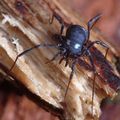

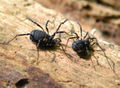
N. bimaculatum und N. lugubre (Foto: H. Wijnhoven)


_und_N._lugubre_(R)1462.jpg)
- Männchen


Gesamtansicht

Penis


Weblinks
Nachweis- und Verbreitungskarten
- Arachnologische Gesellschaft (2020): Atlas der Spinnentiere Europas.
- Staudt A. [Koord.] (2008): Europäische Verbreitung. AraGes e. V.
Weitere Links
Quellen
- Bellmann H (2006): Kosmos Atlas Spinnentiere Europas. Kosmos. 3. Auflage. ISBN 3-440-10746-9, 304 S.
- Komposch C (2009): Rote Liste der Weberknechte (Opiliones) Österreichs. – In: Zulka P. (Red.): Rote Listen gefährdeter Tiere Österreichs. Checklisten, Gefährdungsanalysen, Handlungsbedarf. Grüne Reihe des Lebensministeriums 14/3, S. 397–483.
- Wijnhoven H (2009): De Nederlandse hooiwagens (Opiliones). Supplement Bij Nederlandse Faunistische Mededelingen, 118 S., ISSN 1875-760X.
Quellen der Nachweise
- Angel M & Zarazaga A (undatiert): El Reino Animal en la Península Ibérica y las Islas Baleares.
- Babalean AF (2004): On the opilionid fauna (Arachnida, Opiliones) from the SW part of Romania. Acta Zoologica Universitatis Comenianae 46 (2), S. 79–86.
- Bezděčka P, Bezděčková K & Kvamme T (2017): Revised checklist of Nordic harvestmen (Opiliones) with five species new to Norway. Arachnologische Mitteilungen 54, S. 59–62, doi:10.5431/aramit5413.
- Bezděčka P (2008): Checklist of harvestmen (Opiliones) of the Czech Republic. Klapalekiana 44, S. 109–120, ISSN 1210-6100.
- Blick T & Komposch C (2004): Checkliste der Weberknechte Mittel- und Nordeuropas, Checklist of the harvestmen of Central and Northern Europe (Arachnida: Opiliones) Version 27. Dezember 2004.
- Delfosse E (2017): Catalogue des Opilions de France (Arachnida : Opiliones) - Métropole et Outremer. Revue arachnologique, série 2 n° 4, S. 35–40.
- Heinäjoki M (1944): Die Opilionenfauna Finnlands. Acta Zoologica Fennica 42, 1–26.
- Komposch C (2009): Rote Liste der Weberknechte (Opiliones) Österreichs. – In: Zulka P. (Red.): Rote Listen gefährdeter Tiere Österreichs. Checklisten, Gefährdungsanalysen, Handlungsbedarf. Grüne Reihe des Lebensministeriums 14/3, S. 397–483.
- Kurt K (2014): Updated Checklist of Harvestmen (Arachnida: Opiliones) in Turkey. Arch. Biol. Sci. 66 (4), 1617–1631.
- Kury AB, Kury IS & De Oliveira ABR (2024): Checklists of extant harvestman (Arachnida: Opiliones) species for all the countries of the world. Zootaxa 5515 (1), 1–162.
- Lengyel GD & Murányi D (2006): Data to the Hungarian harvestman (Opiliones) fauna. Folia Historico Naturalia Musei Matraensis 30, S. 117–128.
- Lengyel GD (2010): Contribution to the knowledge of the harvestmen of Hungary (Arachnida: Opiliones). Folia Entomologica Hungarica 71, S. 5–13.
- Martens J (1978): Die Tierwelt Deutschlands 64. Teil, Weberknechte, Opiliones. VEB Gustav Fischer Verlag Jena, 464 S.
- Martín R & Prieto CE (2010): A new orophilous species of the genus Dasylobus (Opiliones: Phalangiidae) from Sierra Nevada, Spain. Journal of Arachnology 38 (1), S. 113–118.
- Mitov PG & Stoyanov IL (2004): The Harvestmen Fauna (Opiliones, Arachnida) of the City of Sofia (Bulgaria) and its Adjacent Regions In: Penev L, Niemelä J, Kotze DJ & Chipev N (eds.), Ecology of the City of Sofia. Species and Communities in an Urban Environment. PENSOFT Publishers, S. 319–354.
- Mitov PG (2000): Contribution to the knowledge of the harvestmen (Arachnida: Opiliones) of Albania. Ekológia (Bratislava) Vol. 19,3, S. 159–169.
- Mitov PG (2007): Opiliones (Arachnida) from the Southern Dobrudzha (NE Bulgaria) and its adjacent regions. Revista Ibérica de Aracnología 15, S. 123–136, ISSN 1576-9518.
- Modebadze N, Martens J, Snegovaya NY & Barjadze S (2023): An annotated list of the Georgian harvestmen (Arachnida, Opiliones). Caucasiana 2, 211–230, doi:10.3897/caucasiana.2.e106544.
- Muster C, Blick T & Schönhofer AL (2016): Rote Liste und Gesamtartenliste der Weberknechte (Arachnida: Opiliones) Deutschlands. Naturschutz und Biologische Vielfalt 70 (4), S. 513–536.
- Muster C, Schönhofer A & Weber D (2013): Weberknechte (Arachnida, Opiliones) aus Höhlen des Großherzogtums Luxemburg [in: Weber Dieter (Hrsg) 2013. - Die Höhlenfauna Luxemburgs]. Ferrantia 69, S. 158–170.
- Muster C (2014): Verbreitungsatlas der Weberknechte des Großherzogtums Luxemburg. Ferrantia 70, S. 1–112.
- N. N. (2018): Biodiversity Ireland – National Biodiversity Data Centre.
- Novak T, Delakorda SL & Novak LS (2006): A review of harvestmen (Arachnida: Opiliones) in Slovenia. Zootaxa 1325, S. 267–276, ISSN 1175-5334.
- Novak T (2004): An overview of harvestmen (Arachnida: Opiliones) in Croatia. Nat. Croat. Vol. 13, No.3, S. 231–296.
- Novak T (2005): An overview of harvestmen (Arachnida: Opiliones) in Bosnia and Herzegovina. Nat. Croat. Vol. 14 No. 4, S. 301–350.
- Pantini P & Isaia M (2019): Araneae.it: the online Catalog of Italian spiders, with addenda on other Arachnid Orders occurring in Italy (Arachnida: Araneae, Opiliones, Palpigradi, Pseudoscorpionida, Scorpiones, Solifugae). Fragmenta entomologica 51 (2), S. 127–152.
- Pfliegler WP, Schönhofer A, Niedbała W, Vella P, Sciberras A & Vella A (2017): New records of mites (Acari) and harvestmen (Opiliones) from Malta with a preliminary checklist of Maltese Arachnida. Soil Organisms 89 (2), S. 85–110, ISSN 2509-9523.
- Prieto CE (2007): Updating the Checklist of the Iberian opiliofauna: corrections, suppressions and additions. Revista Ibérica de Aracnología. 16. Auflage, S. 49–65, ISSN 1576-9518.
- Spungis V (2008): Fauna, Distribution, Habitat Preference and Abundance of Harvestmen (Opiliones) in Latvia. Latvijas Entomologs 45, S. 14–24.
- Vanhercke L (2018): Soortenlijst van de Belgische Hooiwagens.
- Wijnhoven H (2009): De Nederlandse hooiwagens (Opiliones). Supplement Bij Nederlandse Faunistische Mededelingen, 118 S., ISSN 1875-760X.
- unbekannt (undatiert): Estonian eBiodiversity.
