Mitopus morio: Unterschied zwischen den Versionen
Aus Wiki der Arachnologischen Gesellschaft e. V.
Zur Navigation springenZur Suche springen
(Reifezeit) |
(→Bilder) |
||
| Zeile 32: | Zeile 32: | ||
<gallery perrow=3 caption='Männchen'> | <gallery perrow=3 caption='Männchen'> | ||
Bild:Mitopus_morio_m_dorsal.jpg|Männchen dorsal | Bild:Mitopus_morio_m_dorsal.jpg|Männchen dorsal | ||
Bild:Mitopus_morio_m_schraeg.jpg | Bild:Mitopus_morio_m_schraeg.jpg | ||
Bild:Mitopus_morio_m.JPG | Bild:Mitopus_morio_m.JPG | ||
Bild:Mitopus_morio_m2.JPG|mit Milbe | |||
Bild:Mitopus 2.JPG | Bild:Mitopus 2.JPG | ||
Bild:Mitopus 3.JPG | Bild:Mitopus 3.JPG | ||
Version vom 4. August 2010, 18:09 Uhr
| Mitopus morio (Fabricius, 1779) | ||||||||||||||||||||||||||||||||||||||||||
|---|---|---|---|---|---|---|---|---|---|---|---|---|---|---|---|---|---|---|---|---|---|---|---|---|---|---|---|---|---|---|---|---|---|---|---|---|---|---|---|---|---|---|
| Gemeiner Gebirgsweberknecht | ||||||||||||||||||||||||||||||||||||||||||
| Datei:Mitopus morio m frontal.jpg | ||||||||||||||||||||||||||||||||||||||||||
| Männchen in Frontalansicht | ||||||||||||||||||||||||||||||||||||||||||
| Systematik | ||||||||||||||||||||||||||||||||||||||||||
| Ordnung: Opiliones (Weberknechte) | ||||||||||||||||||||||||||||||||||||||||||
| Familie: Phalangiidae (Schneider) | ||||||||||||||||||||||||||||||||||||||||||
| Gattung: Mitopus | ||||||||||||||||||||||||||||||||||||||||||
| Verbreitung in Europa (Blick & Komposch 2004) (Angel & Zarazaga unda) (Milanovic 1990) (Hillyard 2001) (Delfosse 2004) (Stoch 2003) (Stol 2007) (Lengyel & Murányi 2006) (Novak 2004) (Novak et al. 2006) (Komposch et al. 2004) (Kurt et al. 2008) (Babalean 2004) (Bezděčka 2008) (Shavanova 2004) | ||||||||||||||||||||||||||||||||||||||||||
etabliert, nicht etabliert, nicht betrachtet
| ||||||||||||||||||||||||||||||||||||||||||
| Gefährdung nach Roter Liste | ||||||||||||||||||||||||||||||||||||||||||
| ||||||||||||||||||||||||||||||||||||||||||
| Synonyme und weitere Kombinationen | ||||||||||||||||||||||||||||||||||||||||||
|
Biologie
Die Weibchen werden 6,4 bis 8,2 mm groß, die braun gefärbten Männchen 4,2 bis 5,3 mm.
Reifezeit
Adulte Tiere findet man von Mitte Juni bis Mitte November. (Wijnhoven 2009)
Lebensraum
Entsprechend der weiten Verbreitung gehört Mitopus morio zu den euryöken Arten, die fähig sind, vollkommen unterschiedliche Biotope zu besiedeln. Im engeren Mitteleuropa werden Waldgebiete bevorzugt (Martens 1978).
Bilder
- Männchen
- Mitopus morio m dorsal.jpg
Männchen dorsal
- Mitopus morio m schraeg.jpg

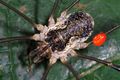
mit Milbe

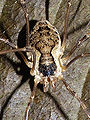


- Weibchen

Dorsal

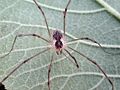
Frontal


Weblinks
Nachweis- und Verbreitungskarten
- Lemke M (2009): Nachweiskarte Östliches Schleswig-Holstein einschließlich Hamburg.
- Arachnologische Gesellschaft (2020): Atlas der Spinnentiere Europas.
- Vanhercke, L. (2004): Opiliones in Belgium.
- Staudt A. [Koord.] (2008): Europäische Verbreitung. AraGes e. V.
Weitere Links
Quellen
- Angel M & Zarazaga A (undatiert): El Reino Animal en la Península Ibérica y las Islas Baleares.
- Babalean AF (2004): On the opilionid fauna (Arachnida, Opiliones) from the SW part of Romania. Acta Zoologica Universitatis Comenianae 46 (2), S. 79–86.
- Bezděčka P (2008): Checklist of harvestmen (Opiliones) of the Czech Republic. Klapalekiana 44, S. 109–120, ISSN 1210-6100.
- Blick T & Komposch C (2004): Checkliste der Weberknechte Mittel- und Nordeuropas, Checklist of the harvestmen of Central and Northern Europe (Arachnida: Opiliones) Version 27. Dezember 2004.
- Delfosse E (2004): Catalogue préliminaire des Opilions de France métropolitaine (Arachnida Opiliones). La Faune De France et D'Outre-Mer, S. 34–58.
- Hillyard P (2001): Newsletter of the Opiliones Recording Scheme. Natural History Museum London No. 4.
- Komposch C, Bliss P & Sacher P (2004): Rote Liste der Weberknechte (Arachnida: Opiliones) des Landes Sachsen-Anhalt. Berichte des Landesamtes für Umweltschutz Sachsen-Anhalt 39, S. 183–189.
- Kurt K, Babaşoğlu A, Seyyar O, Demır H & Topçu A (2008): New faunistic records for the Turkish harvestmen fauna (Arachnida: Opiliones). Mun. Ent. Zool. Vol. 3 No. 2, S. 654–660.
- Lengyel GD & Murányi D (2006): Data to the Hungarian harvestman (Opiliones) fauna. Folia Historico Naturalia Musei Matraensis 30, S. 117–128.
- Martens J (1978): Die Tierwelt Deutschlands 64. Teil, Weberknechte, Opiliones. VEB Gustav Fischer Verlag Jena, 464 S.
- Milanovic MM (1990): A survey of the fauna of harvestmen (Opiliones, Arachnida) of the National Park Durmitor (Montenegro, Yugoslavia). Comptes rendus du XIIème Colloque européen d'Arachnologie. Bulletin de la Société européenne d'Arachnologie No. hors serie 1, S. 261–265, ISSN 0995-1067.
- Novak T, Delakorda SL & Novak LS (2006): A review of harvestmen (Arachnida: Opiliones) in Slovenia. Zootaxa 1325, S. 267–276, ISSN 1175-5334.
- Novak T (2004): An overview of harvestmen (Arachnida: Opiliones) in Croatia. Nat. Croat. Vol. 13, No.3, S. 231–296.
- Shavanova TM (2004): Species composition of the harvestmen (Arachnida: Opiliones) in biocoenoses of the vicinities of Minsk (Belarus). Arthropoda Selecta, European Arachnology 2003 1, S. 293–295.
- Stoch F (2003): Checklist of the species of the Italian fauna. Italian Ministry of Environment.
- Stol I (2007): Checklist of Nordic Opiliones. Norw. J. Entomol. 54, S. 23–26.
- Wijnhoven H (2009): De Nederlandse hooiwagens (Opiliones). Supplement Bij Nederlandse Faunistische Mededelingen, 118 S., ISSN 1875-760X.

