Amilenus aurantiacus: Unterschied zwischen den Versionen
MwBot (Diskussion | Beiträge) Keine Bearbeitungszusammenfassung |
(<ref>{{Lit rl opilio at 2009}}</ref>) |
||
| Zeile 2: | Zeile 2: | ||
{{Infobox Spezies | {{Infobox Spezies | ||
|ordnung=Opiliones | |ordnung=Opiliones | ||
|trivialname=Höhlenlangbein | |trivialname=Höhlenlangbein <ref>{{Lit rl opilio at 2009}}</ref> | ||
|autor=Simon | |autor=Simon | ||
|jahr=1881 | |jahr=1881 | ||
Version vom 21. November 2010, 08:16 Uhr
| Amilenus aurantiacus (Simon, 1881) | ||||||||||||||||||||||||||||
|---|---|---|---|---|---|---|---|---|---|---|---|---|---|---|---|---|---|---|---|---|---|---|---|---|---|---|---|---|
| Höhlenlangbein (Komposch 2009) | ||||||||||||||||||||||||||||

| ||||||||||||||||||||||||||||
| Amilenus aurantiacus | ||||||||||||||||||||||||||||
| Systematik | ||||||||||||||||||||||||||||
| Ordnung: Opiliones (Weberknechte) | ||||||||||||||||||||||||||||
| Familie: Phalangiidae (Schneider) | ||||||||||||||||||||||||||||
| Gattung: Amilenus | ||||||||||||||||||||||||||||
| Verbreitung in Europa (Blick & Komposch 2004) (Angel & Zarazaga unda) (Delfosse 2004) (Stoch 2003) (Martens 1969) (Lengyel & Murányi D 2006) (Novak 2004) (Novak et al. 2006) (Mitov 2000) (Novak 2005) (Bezděčka P 2008) | ||||||||||||||||||||||||||||
etabliert, nicht etabliert, nicht betrachtet
| ||||||||||||||||||||||||||||
| Gefährdung nach Roter Liste | ||||||||||||||||||||||||||||
| ||||||||||||||||||||||||||||
| Synonyme und weitere Kombinationen | ||||||||||||||||||||||||||||
|
syn. Leiobunum aurantiacum; Nelima aurantiaca
Merkmale
Weibchen werden 3,5 bis 5,5 mm groß, Männchen 3,0 bis 3,5 mm.
Gelbbraun bis graubraun mit dunkler Marmorierung. Auf dem Hinterteil befinden sich zwei blitzförmige Zeichnungen, die beim Männchen wegen der dunkleren Färbung weniger gut zu erkennen sind.
Reife Tiere findet man von Dezember bis Juli. (Bellmann 2006)
Fortpflanzung
Die Weibchen legen im Frühling oder Frühsommer Eier am Waldboden ab. Bis zum Herbst erreichen die Jungen das Subadultenstadium. Von September an begeben sie sich in Höhlen oder unterirdische Verstecke, wo zwischen Dezember und Februar die Reifehäutung erfolgt. (Bellmann 2006)
Lebensraum
Krautschicht, Baumstämme und Felsen in feuchten, schattigen Bergwäldern. (Bellmann 2006)
Verbreitung
Hauptverbreitung in den Alpen und süddeutschen Mittelgebirgen, vereinzelt im restlichen Mitteleuropa. (Bellmann 2006)
Bilder

Weibchen
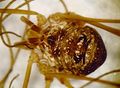
Weibchen

Männchen

Mänchen und Penis
.jpg)
2.jpg)
.jpg)
.jpg)
Weblinks
Nachweis- und Verbreitungskarten
- Lemke M (2014): Nachweiskarte Schleswig-Holstein einschließlich Hamburg (Projekt 2017 beendet und Domain gelöscht).
- Arachnologische Gesellschaft (2020): Atlas der Spinnentiere Europas.
- Tutelaers P (2026): Benelux spider distribution maps.
- Staudt A. [Koord.] (2008): Europäische Verbreitung. AraGes e. V.
Weitere Links
Quellen
- Angel M & Zarazaga A (undatiert): El Reino Animal en la Península Ibérica y las Islas Baleares.
- Bellmann H (2006): Kosmos Atlas Spinnentiere Europas. Kosmos. 3. Auflage. ISBN 3-440-10746-9, 304 S.
- Bezděčka P (2008): Checklist of harvestmen (Opiliones) of the Czech Republic. Klapalekiana 44, S. 109–120, ISSN 1210-6100.
- Blick T & Komposch C (2004): Checkliste der Weberknechte Mittel- und Nordeuropas, Checklist of the harvestmen of Central and Northern Europe (Arachnida: Opiliones) Version 27. Dezember 2004.
- Delfosse E (2004): Catalogue préliminaire des Opilions de France métropolitaine (Arachnida Opiliones). La Faune De France et D'Outre-Mer, S. 34–58.
- Komposch C (2009): Rote Liste der Weberknechte (Opiliones) Österreichs. – In: Zulka P. (Red.): Rote Listen gefährdeter Tiere Österreichs. Checklisten, Gefährdungsanalysen, Handlungsbedarf. Grüne Reihe des Lebensministeriums 14/3, S. 397–483.
- Lengyel GD & Murányi D (2006): Data to the Hungarian harvestman (Opiliones) fauna. Folia Historico Naturalia Musei Matraensis 30, S. 117–128.
- Martens J (1969): Systematische Stellung von Amilenus aurantiacus (Simon) (Opiliones, Phalangiidae). Senckenbergiana biologica 50(3/4), S. 219–224.
- Mitov PG (2000): Contribution to the knowledge of the harvestmen (Arachnida: Opiliones) of Albania. Ekológia (Bratislava) Vol. 19,3, S. 159–169.
- Novak T, Delakorda SL & Novak LS (2006): A review of harvestmen (Arachnida: Opiliones) in Slovenia. Zootaxa 1325, S. 267–276, ISSN 1175-5334.
- Novak T (2004): An overview of harvestmen (Arachnida: Opiliones) in Croatia. Nat. Croat. Vol. 13, No.3, S. 231–296.
- Novak T (2005): An overview of harvestmen (Arachnida: Opiliones) in Bosnia and Herzegovina. Nat. Croat. Vol. 14 No. 4, S. 301–350.
- Stoch F (2003): Checklist of the species of the Italian fauna. Italian Ministry of Environment.
Quellen der Nachweise
- Angel M & Zarazaga A (undatiert): El Reino Animal en la Península Ibérica y las Islas Baleares.
- Babalean AF (2004): On the opilionid fauna (Arachnida, Opiliones) from the SW part of Romania. Acta Zoologica Universitatis Comenianae 46 (2), S. 79–86.
- Bezděčka P & Bezděčková K (2021): Amilenus aurantiacus (Simon, 1881), a harvestman (Opiliones) new to the Czech Republic. Acta rerum naturalium 26, 13–14, ISSN 2336-7113.
- Bezděčka P, Bezděčková K & Kvamme T (2017): Revised checklist of Nordic harvestmen (Opiliones) with five species new to Norway. Arachnologische Mitteilungen 54, S. 59–62, doi:10.5431/aramit5413.
- Bezděčka P (2008): Checklist of harvestmen (Opiliones) of the Czech Republic. Klapalekiana 44, S. 109–120, ISSN 1210-6100.
- Bezděčka P (2021): Dvě novinky v české opiliofauně v roce 2021. Pavouk 51, 5–7, ISSN 1804-7254.
- Blick T & Komposch C (2004): Checkliste der Weberknechte Mittel- und Nordeuropas, Checklist of the harvestmen of Central and Northern Europe (Arachnida: Opiliones) Version 27. Dezember 2004.
- Delfosse E (2017): Catalogue des Opilions de France (Arachnida : Opiliones) - Métropole et Outremer. Revue arachnologique, série 2 n° 4, S. 35–40.
- Heinäjoki M (1944): Die Opilionenfauna Finnlands. Acta Zoologica Fennica 42, 1–26.
- Komposch C (2009): Rote Liste der Weberknechte (Opiliones) Österreichs. – In: Zulka P. (Red.): Rote Listen gefährdeter Tiere Österreichs. Checklisten, Gefährdungsanalysen, Handlungsbedarf. Grüne Reihe des Lebensministeriums 14/3, S. 397–483.
- Kurt K (2014): Updated Checklist of Harvestmen (Arachnida: Opiliones) in Turkey. Arch. Biol. Sci. 66 (4), 1617–1631.
- Kury AB, Kury IS & De Oliveira ABR (2024): Checklists of extant harvestman (Arachnida: Opiliones) species for all the countries of the world. Zootaxa 5515 (1), 1–162.
- Lengyel GD & Murányi D (2006): Data to the Hungarian harvestman (Opiliones) fauna. Folia Historico Naturalia Musei Matraensis 30, S. 117–128.
- Martens J (1969): Systematische Stellung von Amilenus aurantiacus (Simon) (Opiliones, Phalangiidae). Senckenbergiana biologica 50(3/4), S. 219–224.
- Martín R & Prieto CE (2010): A new orophilous species of the genus Dasylobus (Opiliones: Phalangiidae) from Sierra Nevada, Spain. Journal of Arachnology 38 (1), S. 113–118.
- Mitov PG (2000): Contribution to the knowledge of the harvestmen (Arachnida: Opiliones) of Albania. Ekológia (Bratislava) Vol. 19,3, S. 159–169.
- Mitov PG (2007): Opiliones (Arachnida) from the Southern Dobrudzha (NE Bulgaria) and its adjacent regions. Revista Ibérica de Aracnología 15, S. 123–136, ISSN 1576-9518.
- Modebadze N, Martens J, Snegovaya NY & Barjadze S (2023): An annotated list of the Georgian harvestmen (Arachnida, Opiliones). Caucasiana 2, 211–230, doi:10.3897/caucasiana.2.e106544.
- Muster C, Blick T & Schönhofer AL (2016): Rote Liste und Gesamtartenliste der Weberknechte (Arachnida: Opiliones) Deutschlands. Naturschutz und Biologische Vielfalt 70 (4), S. 513–536.
- Muster C, Schönhofer A & Weber D (2013): Weberknechte (Arachnida, Opiliones) aus Höhlen des Großherzogtums Luxemburg [in: Weber Dieter (Hrsg) 2013. - Die Höhlenfauna Luxemburgs]. Ferrantia 69, S. 158–170.
- Muster C (2014): Verbreitungsatlas der Weberknechte des Großherzogtums Luxemburg. Ferrantia 70, S. 1–112.
- N. N. (2018): Biodiversity Ireland – National Biodiversity Data Centre.
- Novak T, Delakorda SL & Novak LS (2006): A review of harvestmen (Arachnida: Opiliones) in Slovenia. Zootaxa 1325, S. 267–276, ISSN 1175-5334.
- Novak T (2004): An overview of harvestmen (Arachnida: Opiliones) in Croatia. Nat. Croat. Vol. 13, No.3, S. 231–296.
- Novak T (2005): An overview of harvestmen (Arachnida: Opiliones) in Bosnia and Herzegovina. Nat. Croat. Vol. 14 No. 4, S. 301–350.
- Pantini P & Isaia M (2019): Araneae.it: the online Catalog of Italian spiders, with addenda on other Arachnid Orders occurring in Italy (Arachnida: Araneae, Opiliones, Palpigradi, Pseudoscorpionida, Scorpiones, Solifugae). Fragmenta entomologica 51 (2), S. 127–152.
- Pfliegler WP, Schönhofer A, Niedbała W, Vella P, Sciberras A & Vella A (2017): New records of mites (Acari) and harvestmen (Opiliones) from Malta with a preliminary checklist of Maltese Arachnida. Soil Organisms 89 (2), S. 85–110, ISSN 2509-9523.
- Prieto CE (2007): Updating the Checklist of the Iberian opiliofauna: corrections, suppressions and additions. Revista Ibérica de Aracnología. 16. Auflage, S. 49–65, ISSN 1576-9518.
- Vanhercke L (2018): Soortenlijst van de Belgische Hooiwagens.
- Wijnhoven H (2009): De Nederlandse hooiwagens (Opiliones). Supplement Bij Nederlandse Faunistische Mededelingen, 118 S., ISSN 1875-760X.
- unbekannt (undatiert): Estonian eBiodiversity.
